
The Wait That Doesn't Have to Happen
Prestige Health Partners Research
Georgia's Developmental Disability Crisis — and the Hidden Pathway Most Families Miss
Nearly as many Georgians are waiting for developmental disability services as are currently receiving them. The NOW/COMP waiver waitlist has held above 6,000 people for more than a decade. For families added today, the realistic projection isn't months — it's years, and in many cases, decades.
But for medically fragile children under 21, a parallel pathway exists. No waitlist. No slot lottery. Care can begin in as little as 30 days.
Most families never hear about it. This report changes that.

Key Statistics
A System That Can't Close the Gap
Georgia's NOW/COMP waiver system was designed to keep people with developmental disabilities living in their homes and communities — not in institutions. By that measure, it serves an important purpose. By the measure of supply and demand, it is failing at scale.
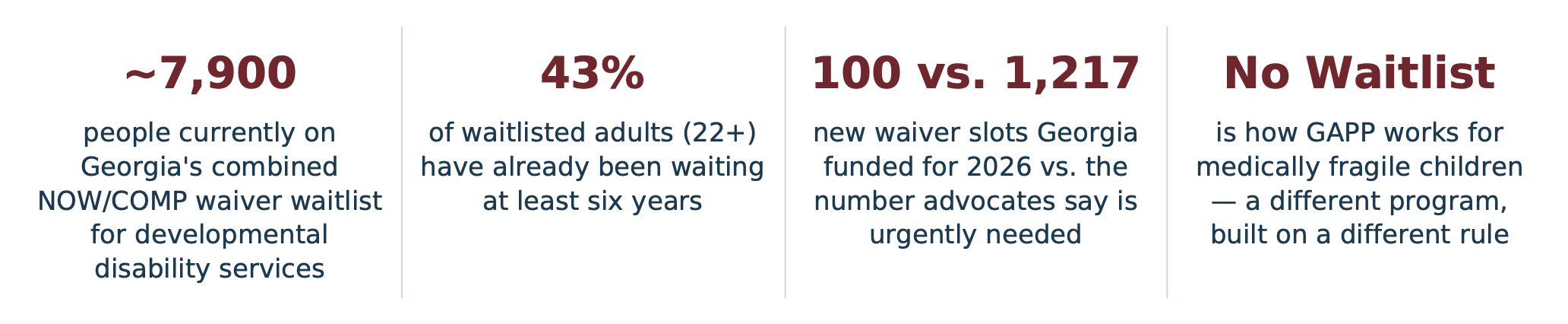
Approximately 7,900 Georgians are currently on the waitlist. Roughly 14,100 to 14,294 are enrolled and receiving services today. That ratio — one person waiting for nearly every two being served — has persisted for over a decade, according to the Georgia Council on Developmental Disabilities (GCDD). The waitlist has never once dropped below 6,000 individuals in that time.
The math for 2026 tells the story plainly. State advocates identified 1,217 people with urgent, pressing needs — individuals hospitalized with nowhere to go, adults whose aging caregivers can no longer provide support, and young adults aging out of school services. Georgia's legislature funded 100 new waiver slots in response. That's less than 10% of identified urgent need.
Meanwhile, roughly 400 people leave the waitlist each year — not because they received services, but because they died or relocated. The waitlist isn't a pipeline moving people toward care. For too many families, it's a permanent holding pattern.
But buried inside this broken system is a structural exception. The Georgia Pediatric Program (GAPP), administered by the Georgia Department of Community Health, serves medically fragile children under 21 — children dependent on respirators or oxygen, or requiring skilled nursing and personal care — through a fundamentally different mechanism. GAPP approvals are based on documented medical necessity and clinical review, not slot availability. There is no waitlist.
According to Prestige Health Partners, a Georgia-based provider of Medicaid-accepted in-home care for children and young adults with developmental and physical disabilities, qualifying families can move from application to active care in approximately 30 days. The knowledge gap between families who know to ask about GAPP and those who don't is, in real terms, the difference between care starting next month and care starting next decade.
3 Takeaways for Georgia Residents
1. Don't Assume the Waitlist Is Your Only Option
If your child is under 21 and has complex medical needs — including dependency on respiratory equipment or the ongoing need for skilled nursing care — GAPP eligibility should be assessed before you accept a multi-year wait as inevitable. The program is authorized, Medicaid-accepted, and operates on an entirely different approval timeline.
2. Ask Your Care Coordinator About GAPP — Directly
Too many families enter the NOW/COMP waitlist without being told GAPP exists. Hospital discharge planners, school transition specialists, and Medicaid navigators should be screening for GAPP eligibility for every medically fragile child. If yours hasn't raised it, ask.
3. Start the Documentation Process Now
The families who access GAPP fastest are those who begin building clinical documentation before a crisis forces the timeline. Proactive application — supported by clear documentation of medical necessity — is the single most effective way to compress the path to care.
"A child with both a developmental disability and complex medical needs does not have to wait years for skilled nursing support simply because a NOW or COMP slot isn't available. The waitlist crisis is real — but for medically fragile children, there is a parallel pathway that most families don't know to ask about. That knowledge gap is the difference between care starting next month and care starting next decade."
-Brian Ferguson, CEO, Prestige Health Partners
Why this matters
GAPP isn't a workaround. It's a fully authorized Medicaid program administered by the Georgia Department of Community Health. The barrier isn't eligibility — it's awareness. Families who never learn GAPP exists spend years on a waitlist that, statistically, hundreds will never reach the front of. Connecting families to the right pathway at the right time is not a minor administrative improvement. It is the difference between a child receiving skilled nursing care during their most critical developmental years — or not.
About the Study
"The Wait That Doesn't Have to Happen" was prepared in partnership with Prestige Health Partners, a Georgia-based provider of Medicaid-accepted in-home care for children and young adults with developmental and physical disabilities. The report synthesizes publicly available data from the Georgia Council on Developmental Disabilities and the Georgia Department of Community Health to document the NOW/COMP waitlist crisis and surface the GAPP alternative pathway. All figures are drawn from cited government and advocacy sources. No data was invented or extrapolated. The report is intended to inform families, care coordinators, and advocates — not to serve as legal or clinical guidance.
5 Frequently Asked Questions
What is the NOW/COMP waiver, and why is the waitlist so long?
The NOW (New Options Waiver) and COMP (Comprehensive Supports Waiver) programs fund home- and community-based services for Georgians with developmental disabilities. Both are capped — the state allocates a fixed number of enrollment slots, and demand has outpaced supply for more than a decade. The Georgia Council on Developmental Disabilities confirms the waitlist has never fallen below 6,000 individuals in that time. With only 100 new slots funded for 2026 against 1,217 identified urgent cases, the gap is not closing.
What is GAPP, and who qualifies?
The Georgia Pediatric Program (GAPP) is a Medicaid-accepted program administered by the Georgia Department of Community Health. It serves medically fragile children under 21 who are dependent on respirators or oxygen, or who require ongoing skilled nursing and personal care. Unlike NOW/COMP, GAPP is not a capped waiver — approvals are based on documented medical necessity and clinical review. There is no waitlist.
How is a 30-day timeline possible when the NOW/COMP waitlist spans years or decades?
GAPP operates on a different approval mechanism. Because eligibility is determined by medical documentation — not slot availability — the application-to-care timeline is governed by review speed, not queue position. According to Prestige Health Partners, qualifying families can begin receiving care in approximately 30 days from application.
Can a child qualify for GAPP if they also have a developmental disability?
Yes. A child with both a developmental disability and qualifying complex medical needs is not limited to the NOW/COMP pathway. GAPP eligibility is assessed independently, based on the child's medical condition and documented care needs. Families should not assume that a developmental disability diagnosis automatically routes their child to the general waiver waitlist.
How do I find out if my child qualifies for GAPP?
The fastest route is to speak with a provider experienced in navigating both the NOW/COMP and GAPP systems. Prestige Health Partners serves families across the Atlanta area and can help assess whether GAPP or another pathway applies to your child's situation — and how quickly care could begin. Call 678.628.7632 today.
You May Not Have to Wait
If your child has complex medical needs and you've been told a long waitlist is your only option — that may not be true.
Prestige Health Partners is a Georgia-based provider of Medicaid-accepted in-home care for children and young adults with developmental and physical disabilities, serving families across the Atlanta area. Their team helps families understand whether GAPP or another pathway applies to their child's situation, and how quickly care can begin.