
One in Four Children in North Atlanta Has a Special Health Care Need. Most Are Navigating It Alone.
Prestige Health Partners Research
New research from Prestige Health Partners quantifies the gap between the scale of need and the availability of coordinated care — across six counties, 166,000+ children, and one family at a time.
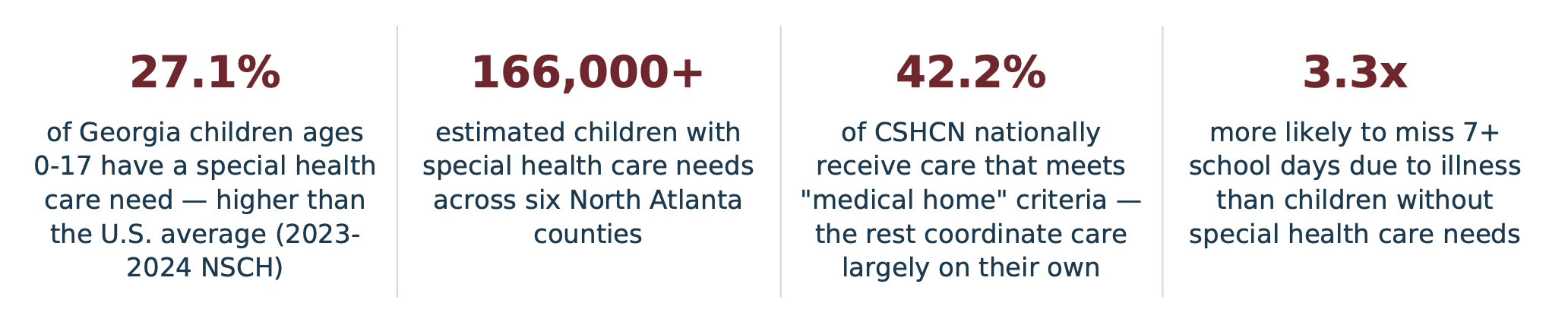
Georgia isn't an outlier. It's a mirror. With 27.1% of children ages 0–17 meeting the clinical definition of a special health care need, Georgia sits above the national average — and North Atlanta's six-county region alone carries an estimated 166,752 children who need more than routine pediatric care. The challenge isn't that these families are invisible. It's that the system hasn't caught up to their reality.

Key Statistics
Research Narrative
Children with special health care needs aren't a footnote in Georgia's pediatric health landscape. They're the headline.
According to the most recent National Survey of Children's Health (2023–2024), 27.1% of Georgia children ages 0–17 have a special health care need — ranking the state 20th nationally and just above the 27.0% U.S. average. These are children living with conditions like autism spectrum disorder, cerebral palsy, epilepsy, Down syndrome, ADHD, anxiety, and developmental delays, whose care routinely extends well beyond annual checkups. The national range runs from 20.9% in Hawaii to 32.5% in Kentucky, which means this is a condition of American childhood — not a regional anomaly.
Prestige Health Partners applied that 27.1% rate to U.S. Census Bureau population estimates for six North Atlanta counties — Forsyth, Gwinnett, Hall, Dawson, Cherokee, and Fulton — which together are home to roughly 615,000 children under 18. The result: an estimated 166,752 children in this region who require ongoing prescriptions, specialized therapies, functional support, or care coordinated across multiple providers. Gwinnett County leads with an estimated 62,517 CSHCN children. Fulton follows with approximately 58,105. Together, those two counties account for more than 120,000 of the regional total.
Scale alone doesn't tell the full story. What compounds the challenge is what happens — or doesn't happen — after a child is identified. Nationally, only 42.2% of CSHCN children receive care meeting the clinical definition of a "medical home": accessible, continuous, coordinated, and family-centered. Georgia's rate is modestly better at 48.5%, but that still means the majority of families in this region are managing specialist schedules, medication protocols, therapy referrals, and insurance paperwork largely without structured support. Only 62.5% of CSHCN children nationally have adequate, continuous insurance coverage — adding another layer of complexity to an already demanding caregiving reality.
The downstream effects are measurable. CSHCN children are 3.3 times more likely than their peers to miss seven or more school days per year — 21.4% vs. 6.4% — a gap that compounds developmental, educational, and social risk over time.
3 Takeaways for North Atlanta Residents
1. Your child's diagnosis is more common than you think — and that changes what's available to you. More than one in four Georgia children meets the clinical criteria for a special health care need. If your child has a diagnosed condition that affects their daily functioning, schooling, or care requirements, Medicaid-covered in-home support may be within reach.
2. Fragmented care isn't a personal failure — it's a system gap. Fewer than half of CSHCN families nationally have access to coordinated care. If you're managing multiple providers, therapy schedules, and insurance questions without support, that's not unusual. It's the gap in-home care coordination is specifically designed to fill.
3. School absences may be a signal worth acting on early. CSHCN children miss significantly more school than their peers. Chronic absences tied to illness or care appointments can be an early sign that a child needs more structured, at-home support — before the educational and developmental costs accumulate.
"The families behind these estimates aren't looking for more information — they're looking for coordinated, in-home support that meets them where the system hasn't."
-Brian Ferguson, CEO, Prestige Health Partners
That framing matters. The data in this study doesn't describe a hard-to-find population requiring specialized outreach. It describes children in classrooms, in pediatric waiting rooms, and in households across every zip code in North Atlanta. What these families share isn't just a diagnosis — it's a common experience of navigating complexity without a consistent guide. Prestige Health Partners built its model around exactly that gap: providing Medicaid-covered in-home care that brings coordination, consistency, and clinical support directly to the families who need it most, rather than asking those families to find their way to it.
About the Study
Sizing Georgia's CSHCN Population was prepared by Prestige Health Partners to estimate the population of children with special health care needs across six North Atlanta counties: Forsyth, Gwinnett, Hall, Dawson, Cherokee, and Fulton. Prevalence data comes from the 2023–2024 National Survey of Children's Health, administered by the U.S. Census Bureau on behalf of HRSA's Maternal and Child Health Bureau — the definitive federal source for state-level CSHCN estimates. County-level population figures draw on U.S. Census Bureau QuickFacts. Supporting data on medical home access, insurance adequacy, and school absence rates come from NSCH data briefs spanning 2017–2023. No primary data was collected.
5 FAQs
What does "special health care need" actually mean?
A child meets the clinical definition of a special health care need if they have a recognized condition — such as autism, ADHD, cerebral palsy, epilepsy, anxiety, or developmental delays — combined with at least one of five criteria: needing prescription medication, requiring above-average medical or educational services, experiencing a functional limitation, receiving specialized therapy, or being treated for an emotional, behavioral, or developmental condition. The standard is set by a validated five-item screener developed by the Child and Adolescent Health Measurement Initiative (CAHMI).
Where does the 166,752 estimate come from?
Prestige Health Partners applied Georgia's 27.1% CSHCN prevalence rate (NSCH 2023–2024) to U.S. Census Bureau population estimates for children under 18 across the six-county North Atlanta region. The six-county child population totals approximately 615,322. These are modeled estimates — the NSCH is designed for state-level precision — but the methodology follows standard regional health planning practice.
Why does it matter that fewer than half of CSHCN children have a medical home?
A coordinated medical home means care that is accessible, continuous, comprehensive, and coordinated across providers. Without it, families are left to manage specialist referrals, therapy schedules, medication protocols, and insurance navigation independently — a burden that frequently leads to missed appointments, delayed care, and the kind of school absences the data documents. Coordination isn't a luxury for this population. It's a clinical necessity.
Does Medicaid cover in-home care for children with special health care needs in Georgia?
Many children who meet the CSHCN criteria are eligible for Medicaid-covered in-home support, including services provided by Prestige Health Partners. Eligibility depends on diagnosis, functional need, and Medicaid program specifics. Prestige Health Partners can help families understand what coverage may be available and how to access it. Call 678.628.7632 to get started.
Which counties does Prestige Health Partners serve?
Prestige Health Partners serves families across the North Atlanta region, with primary focus on Gwinnett and Fulton counties — which together account for more than 120,000 estimated CSHCN children — as well as Forsyth, Cherokee, Hall, and Dawson counties.
The Need Is Here. So Is the Support.
If your child or a child you know has a special health care need, you don't have to coordinate everything alone. Prestige Health Partners provides Medicaid in-home care for children and young adults with developmental and physical disabilities across North Atlanta — bringing care coordination, clinical support, and consistent caregiving directly to your family.